

As one of the largest independent advertising firms in New England, it’s hard find another advertising firm that’s been around as long as we have. Since our founding in 1948, we’ve provided exceptional service to our clients, spanning multiple locations and industries. The positive results we’ve driven for our partners has not gone unnoticed. In [ … ]

Davis Advertising Receives 3rd Clutch Award for 2018
As the saying goes, good things come in threes. Earlier this year, Davis Advertising was recognized by ratings and review firm Clutch as one of the top advertising agencies of the Boston area. Later, Davis was once again recognized by Clutch as one of the leading branding agencies in the US as well as a [ … ]
Davis Advertising Named as an Agency Leader in Branding
Davis Advertising has once again been featured as a leading advertising agency for our stellar performance in client services. This recognition comes from Clutch, an industry-leading business service rankings site that focuses on agencies’ ability to deliver successful partnerships. As part of this recognition, Davis Advertising is featured on Clutch’s coverage of top advertising agencies [ … ]

Is Video Still King?
Long gone are the days when broadcast advertisers could guarantee an audience’s full attention for the video ads played during commercial breaks. And while you likely don’t pine for that TV set offering just a handful of networks with a knob to change channels and no way to fast-forward; who doesn’t want to relive the [ … ]
Davis Advertising Performs Across Industries
Every industry has its own marketing trends. This should be obvious. With the number of different customers in each vertical, it’s amazing to us that some ad agencies try to apply the same approach regardless of which industry they’re serving. At Davis Advertising, we know that our B2B clients are different from our higher education [ … ]
Mobile First Website Design and Development
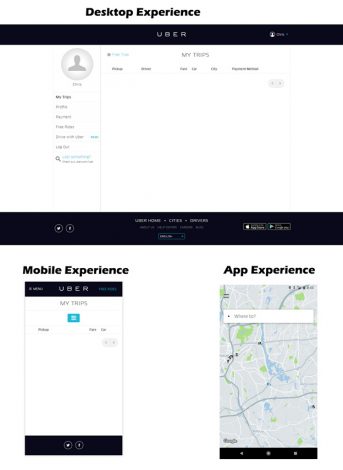
Davis Advertising creates interactive websites, so your customers can achieve their goals. This is an important statement, and one that should immediately resonate with a company that puts its customers first. We build highly engaging websites based on UX, or the User Experience. Maximizing your user experience now requires a ‘mobile-first’ design model. Unless your [ … ]
Davis Advertising Featured As Leading Ad Agency by Clutch
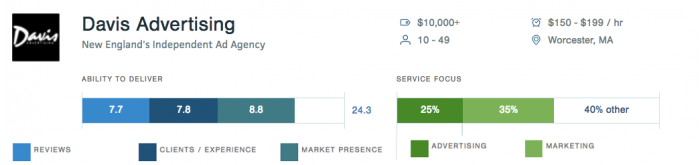
It’s no secret that Boston features a competitive landscape of digital marketing, traditional advertising, and creative agencies. At Davis Advertising, we maintain our competitive edge in these arenas with strategic solutions for our clients and holistic in-house services that bring results. Our experienced team works hard to share our knowledge of Boston’s marketing landscape and [ … ]
What does your Account Executive bring to the table?
I think the most accurate place to go for definitions for phrases is Urban Dictionary. Granted, a majority of the phrases you can look up there are NSFW, but one of my favorite expressions is defined on the site. I Know A Guy — A phrase to calm your friend down after he/she has done [ … ]
Higher Education: Marketing to and Recruiting Non-traditional Students
Technology and globalization have disrupted our economy. American workers have been displaced, replaced, outsourced and made obsolete by technological innovations across each and every industry. Jobs in today’s economy require that workers acquire new skills and training. When workers have skill sets that are NOT in line with those that are needed, the result is [ … ]
The Importance of Listening: Interpreting Google Analytics Data
How can you tell when people stop caring about your website? How can you tell if they even cared at all? If you’ve implemented Google Analytics to track user activity on your website, but you’re not really sure about how to read the data, then this article is for you. You’ll learn how to read [ … ]
Are You a Hero or a Villain?
There’s one surefire way to tell who is the ‘bad guy’ in a movie or book– It’s to hear how the plan is going to take place. If the character launches into a long rant, chances are he or she is the bad guy. Good guys don’t monologue. Why do bad guys do that? It [ … ]
Please Like My Facebook Content!
Lately I’ve noticed an awkward trend in marketing, one that simply does not make any sense to me at all. That is, bad content being boosted in Facebook. “This post isn’t being liked by anyone. Maybe it’s just not reaching the right audience. Let’s boost it, so more people can see it!” Whoa, now. I [ … ]
3 Simple Tips to Improve Your Cyber Monday Shopping
‘Tis the season to start stimulating the economy! While you begin your hunt for the perfect holiday gifts, there are a few tips and tricks we can give to help you make the most of your holiday shopping. 1. Keep yourself safe The last thing you need to do while shopping is spread your credit [ … ]
An Inside Look at Advertising Week New York 2015
Advertising Week in New York only finished half the schedule and there is already some huge news coming from the likes of Google, Facebook, Yahoo and other key players. If you missed it here is some of the news so far: Google News: Google announced a new way of targeting which has many advertisers excited. [ … ]
Keys to the Google AdWords kingdom
If you’ve ever done a Google search — and who hasn’t? — you’ve inevitably noticed the paid ad placements similar to the one above. These uniquely powerful ads — dubbed “Google AdWords” — represent one of the easiest and most effective ways to get your brand noticed. In fact, using AdWords, small businesses can compete [ … ]
5 Facebook Advertising Tips for Community Colleges
In 2014, 61% of high school students used Facebook every day and 87% of total high school students used Facebook based on a Niche.com survey of 7,000 2014 grads. If you are trying to make sure that your community college’s message gets out to students, there is no better way. No other platform that can [ … ]
Boston Advertising – The Importance of Segmentation
There are many benefits to advertising in Boston and other large cities around the world. However, it is not a cut-and-dry tactic. For various companies, marketing in Boston requires a heightened focus on market segmentation. Segmentation is typically defined by splitting up your target market into categories often based on some of the following factors: [ … ]
5 Google Adwords Tips for Community Colleges
Advertising on Google Adwords for community colleges is crucial. The ability to target people searching for schools in their area and colleges offering the programs they want to take can yield some fantastic results; the professionals here at Davis have seen it firsthand. Here are some of the Agency’s tips for setting up your Google [ … ]
Biting into Food Photography at Davis
Here at Davis, we take pride in knowing our clients as well as they know themselves. A fully-integrated advertising agency is in fact an extension of the client’s business. This simple notion is prevalent in every department, including an area as tasty as professional food photography! Let’s take a look at the steps we take [ … ]
The Dos and Don’ts of Writing Press Releases
Press releases are the key to providing media outlets with news for your company, whether it’s an event, promotion, award, new product or service or even to generate a story lead. But in order for the news to generate attention, there are certain elements to keep in mind—and to avoid—when creating a press release. To [ … ]
- 1
- 2
- 3
- …
- 13
- Next Page »